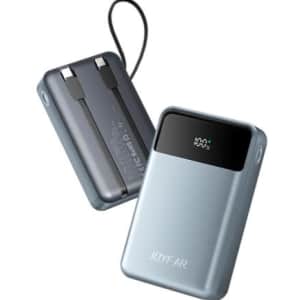
It's the best deal we've seen for a 2-pack of these power banks. Buy Now at Woot! An Amazon Company
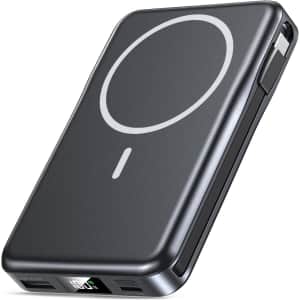
That's $55 under its typical price. Buy Now at Amazon
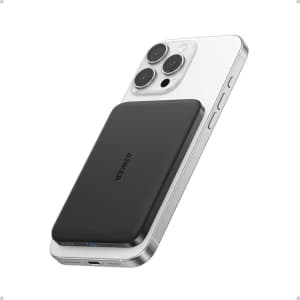
It's a low by $11 with promo code "SSF95". Buy Now at Newegg
- 0.3" slim
- 15W
- Model: A1665
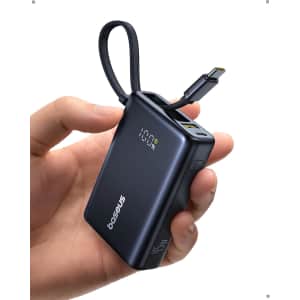
Prime members can apply coupon code "QNGPNF9A" for a savings of $20. Buy Now at Amazon
- Includes built-in USB-C cable
- PD 45W Ultra Fast Charging Technology
- Smart LED Display & Compact and Portable
- 10000mAh Capacity for Widely Devices
- Two-Way Fast Charging Cable
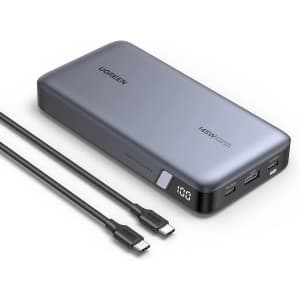
That's 34% off and the lowest price it's been at Amazon. Buy Now at Amazon
- 2 USB-C ports; 1 USB-A port
- PD3.0 and QC3.0 charging technology
- Model: 90597A
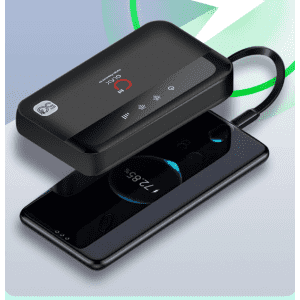
A similar power bank and mobile router combo would usually cost you at least $30 elsewhere. Of note, this purchase will also garner $8.36 in import and payment processing fees.
New Alibaba customers get free shipping; otherwise, it starts at around $10. Buy Now at Alibaba
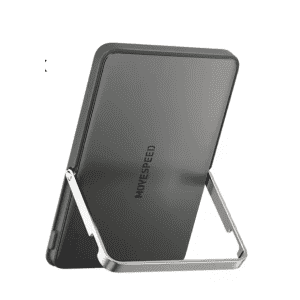
That's the lowest price we could find by $13. It ships for free from a U.S. warehouse. Buy Now at AliExpress
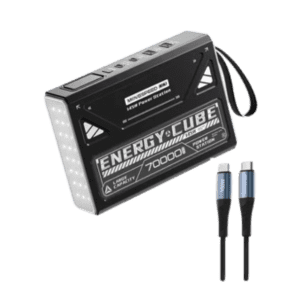
That's the lowest price we could find by $89 after apploying promo code "USBS08". It ships free from a U.S. warehouse, too. Buy Now at AliExpress
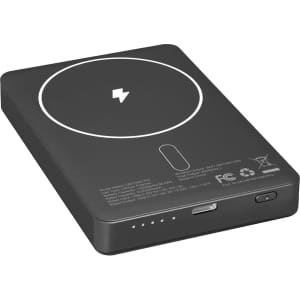
It's the best price we could find by $19. My Best Buy members get free shipping on all orders, too (it's free to join). Buy Now at Best Buy
- Qi/Qi2.0/MagSafe compatible
- 1 USB-C port
- Model: QM10081PQ
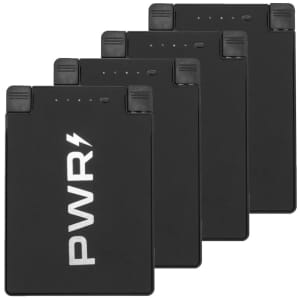
MorningSave offers the PWRCard 2,500mAh Slim Power Bank 4-Pack for $10 (reduced from $133). Plus, get free shipping with code "DEALNEWS". Buy Now at MorningSave
- integrated USB-C, Lightning, and Micro USB cables
- LED indicators show you how much charge is remaining
- works with both Apple and Android devices
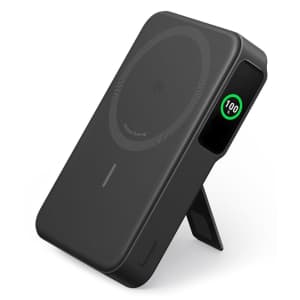
That's the best price we've seen and a $31 low. Buy Now at Amazon
- smart screen
- 10,000mAh
- USB-C to USB-C cable
- optimized for the iPhone 12/13/14/15 series w/ 15W magnetic fast charging
- Model: A1654
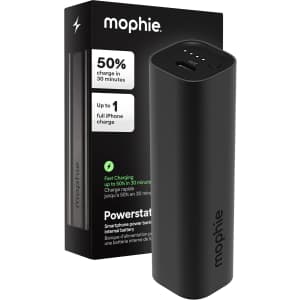
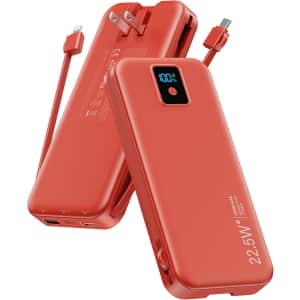
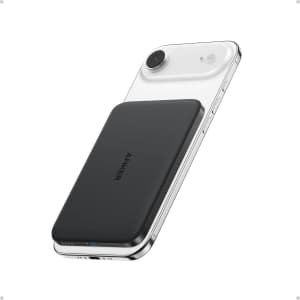
That's the second-best price its ever been. Buy Now at Amazon
- Qi2-certified
- compatible with MagSafe
- 5,000mAh
- Model: A1665
That's $31 off and the lowest price we've seen. Buy Now at Amazon
- smart screen
- 10,000mAh
- USB-C to USB-C cable
- optimized for the iPhone 12/13/14/15 series w/ 15W magnetic fast charging
- Model: A1654
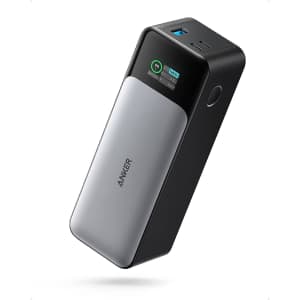
It's the best price we could find by $35. Buy Now at Amazon
- 140W output
- smart digital display
- charges 3 devices at once
- Model: A1289

It's $11 off in Black. Buy Now at Amazon
- 3 output cables & 1 input cable
- 6 outputs & 3 inputs
- Model: W1148
That's a 30% savings. Buy Now at Amazon
- suppots Qi2 certification
- up to 20W max USB-C output
- 15W MagSafe-Compatible Charging
- Model: A1665
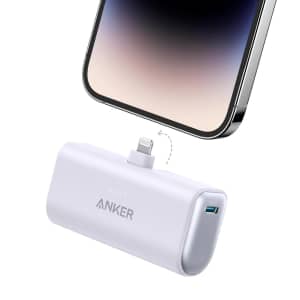
That's by far the best deal Amazon has ever offered on it. It's normall listed around $30. Buy Now at Amazon
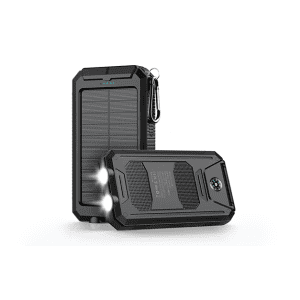
To get this solar power bank, you will only be charged a processing & shipping fee of $4.99. After 14 days, you will receive a Survivalist Box every month and be billed $47 per month. You will also receive a conditional gift card of $50 to shop at Mytacticalpromos.com for Survivalist Gear.
There is no commitment required. Cancel at any time. Shop Now at My Tactical Promos
The portable power bank market has evolved from a simple emergency backup into a sophisticated mobile energy infrastructure. As our reliance on power-hungry flagship smartphones, tablets, and even USB-C laptops has grown, the need for high-density lithium-ion storage has become a travel necessity. Unlike the early days of bulky, slow-charging bricks, today's market is dominated by ultra-slim magnetic packs, high-wattage laptop-grade banks, and massive portable power stations capable of running small appliances. By leveraging seasonal e-commerce cycles and technical "sweet spots" in capacity, deal hunters can secure high-performance energy solutions for a fraction of the standard retail price.
The primary value proposition of the third-party power bank market lies in the disparity between "brand name" markup and raw battery capacity. By tracking "Staff Picks" and utilizing site-wide promo codes at sites like vATT, shoppers can build a versatile "power kit" that ensures they are never tethered to a wall outlet, while saving 50% to 70% compared to big-box retail prices.
Top Power Bank Categories to Watch for Discounts
Not all power banks are created equal, and the "best deal" depends entirely on what device you need to keep alive. In the current market, capacity is only one part of the equation; output speed and mounting technology are equally important. Based on DealNews historical data, these are the four specific categories where shoppers can find the most significant price drops and the best "bang for your buck" in terms of mobile energy.
Magnetic and Qi2-Certified "Snap-On" Banks: The iPhone Essential
Designed specifically for the iPhone 12 through 16 series, these compact packs eliminate the need for tangled cables by snapping directly onto the back of the device via an internal magnetic array. They are the premier choice for commuters and travelers who need a "pocketable" power boost without the bulk of a traditional brick-and-wire setup.
- What to Look For: Prioritize hardware with "Qi2 Certification." This is the new open-industry standard that provides 15W fast charging—matching official Apple MagSafe speeds—but at a third-party price point. Older magnetic banks are often limited to 7.5W, which can be painfully slow for modern high-capacity batteries.
- The Deal Landscape: While these units frequently MSRP for $70 or more, we have tracked high-performance Anker Qi2 15W MagGo banks for $19.99 and Energizer 10,000mAh magnetic packs for just $16. These deals represent the most efficient way to secure "Apple-level" performance for a fraction of the official accessory cost.
High-Wattage Laptop-Grade Banks (65W–140W): Professional Power
These are the "heavy hitters" of the market, designed to provide enough sustained energy to power a MacBook Pro, Dell XPS, or a handheld gaming console like the Steam Deck at full speed. For these devices, a standard phone charger is insufficient; you need a bank that can output high wattage through a single port.
- What to Look For: High wattage is the non-negotiable metric here. A power bank that only outputs 15W will charge a laptop so slowly that the battery may still drain while the device is in use. To ensure a "deal" is actually functional for pro gear, look for a minimum of 65W with Power Delivery (PD) 3.0 or 3.1 support.
- The Deal Landscape: Recent "Staff Picks" include the Ugreen 100W/25,000mAh unit for $66 (a 34% discount) and the Movespeed 140W bank for $71. These high-wattage units offer the best "cost-per-watt" for digital nomads and power users who need to maintain a mobile office.
Ultra-High Capacity "Monster" Banks (30,000mAh – 60,000mAh): Emergency Prep
These units are designed for multi-day camping trips, music festivals, or emergency home backup. While they are far too heavy for a pocket, they serve as the ultimate insurance policy against a prolonged power outage. Because of their sheer size, they are often used as "charging hubs" for entire families.
- What to Look For: Look for Port Variety. Because these are designed to charge multiple devices at once, ensure the unit features at least four output ports and, ideally, an integrated LED flashlight for emergency visibility.
- The Deal Landscape: The value in this category is found in extreme capacity-to-price ratios. We have seen 60,000mAh bricks drop to as low as $36 (down from a $250 MSRP). These are often found as "Flash Deals" on Amazon or as high-volume multi-packs on Woot, such as the Joyfar 30,000mAh 2-packs for $28, which are ideal for stashing in a vehicle's emergency kit.
Portable Power Stations: The Off-Grid Solution
When a pocket-sized bank isn't enough, portable power stations (often called "Solar Generators") provide full-sized AC outlets for small appliances, CPAP machines, and high-end photography rigs. These are essentially massive battery arrays housed in a durable chassis with professional-grade inverters.
- What to Look For: Demand LiFePO4 battery chemistry. This newer technology allows the station to last for 3,000+ charge cycles (roughly 10 years of daily use) compared to the 500 cycles of standard lithium-ion. Additionally, check for "Pass-Through Charging," which allows you to use the station's outlets while it is being recharged by solar panels or a wall socket.
- The Deal Landscape: These are high-ticket items where promo codes and seasonal sales make a massive difference. We recently tracked the EcoFlow Delta 2 (1,024Wh) for $399, representing a staggering $600 discount from its $999 MSRP. These deals are most common on eBay and Amazon during seasonal "Outdoor" sales or "Prime Day" events.
Comparing Power Bank Savings Across Key Retailers
Where you source your mobile power dictates the balance between technical reliability, shipping speed, and absolute lowest cost-per-mAh. While generic power banks are available at almost every checkout counter, savvy deal hunters know that specific retailers cater to different "power profiles"—from ultra-cheap high-capacity bricks to professional-grade laptop stations.
Retailer Comparison Table
|
Retailer |
Primary Deal Type |
Key Benefit |
Risk/Effort Level |
|
ATandT |
Premium Accessory Bundles |
Guaranteed authentic Belkin/OtterBox; MFi-certified. |
Medium (Best when bundled with cases). |
|
AliExpress |
Direct-from-Factory |
Extreme high-capacity (30k-60k mAh) for low prices. |
High (Shipping times; check "Choice" status). |
|
Newegg |
Technical Enthusiast Sales |
Precise specs for laptop-grade (100W+) power banks. |
Low (Great promo code integration). |
|
Samsung |
Ecosystem Synergy |
Perfectly tuned for "Super Fast Charging" protocols. |
Low (Premium build, but limited variety). |
ATandT: The Premium Bundle Specialist
ATandT is a primary destination for shoppers who prefer established, retail-grade names like Belkin, Mophie, and OtterBox. While their individual shelf prices often reflect a high "convenience markup," ATandT's true value lies in its "Multi-Buy" promotional strategy. During holiday windows and major smartphone launches, they frequently offer 25% to 30% off when you purchase three accessories simultaneously.
For the consumer, this is the most reliable way to secure high-quality hardware—like the Belkin 10,000mAh Fast Charge bank with integrated cables—at deal prices. We recently tracked this specific model for just $15, representing a 60% discount. Because ATandT is a major carrier, you are guaranteed to receive a genuine product with a full manufacturer warranty, making this the best choice for those who want "no-risk" hardware.
AliExpress: The High-Capacity Value Leader
AliExpress has some deep discounts and serves as the frontline for direct-from-manufacturer brands like Movespeed, Xiaomi, and Baseus. This is the only marketplace where deal hunters can consistently find the most aggressive pricing on massive storage capacities and niche hardware. Recent marketplace data highlights the extreme discounts available: 140W laptop-grade power banks for $71 (down from a $201 MSRP) and 10,000mAh magnetic "Snap-on" packs for just $22.
To maximize safety and value on AliExpress, shoppers should prioritize items with "Choice" status for faster, more reliable shipping and stick to the "Official Stores" within the platform. This ensures you receive genuine lithium-ion cells rather than lower-quality "sand-filled" fakes that sometimes plague unverified third-party listings. For those who need a 30,000mAh to 60,000mAh "monster" bank for camping or festivals, AliExpress offers the lowest cost-per-mAh in the industry.
Newegg: Precision Power For Professionals
Newegg has great deals and is the go-to for shoppers who need technical specificity, such as Power Delivery (PD) 3.1 or high-wattage 140W output capable of charging a MacBook Pro or a high-end gaming laptop. Unlike generalist retailers, Newegg's search filters allow users to browse by exact port configurations and wattage specs. They are also aggressive with stackable promo codes; for example, we recently saw a $11 discount on Anker Nano magnetic packs using the promo code "SSF95."
Beyond pocket-sized banks, Newegg acts as a secondary hub for EcoFlow and Jackery portable power stations. They frequently feature "Open Box" or "Seller Refurbished" units that can save professional users hundreds of dollars on 1,000Wh+ backup power systems. If your priority is charging a laptop or a drone rig, Newegg's enthusiast-focused inventory provides the most reliable technical depth.
Samsung: Specialized Charging For Galaxy Owners
Samsung is another great place to look for deals produces a limited but highly specialized line of power banks designed specifically for the Android ecosystem. These units are tuned to support Samsung's proprietary "Super Fast Charging" 2.0 (PPS) protocols, ensuring that Galaxy S-series and Z-Fold users get the same speeds they would from a wall outlet. While you won't find the same variety here as you would with Anker, Samsung's hardware is built with premium materials and advanced thermal sensors.
The best deals on Samsung power banks usually occur during "Samsung Week" in the fall or as high-value "add-on" incentives during a new smartphone preorder. It is not uncommon to see a $50 power bank included for free or discounted to $10 when bundled with a new phone. For those committed to the Galaxy ecosystem, these official banks offer the best "handshake" between the battery and the device, maximizing battery health longevity.
The Power Bank Buying Calendar: Strategic Timing
In the world of mobile accessories, pricing is rarely static. Because lithium-ion battery technology moves in rapid cycles and seasonal demand fluctuates based on travel habits, deal hunters can save significantly by aligning their purchases with specific retail events. Understanding the "Buying Calendar" allows you to distinguish between a standard marketing markdown and a genuine, once-a-year price floor.
Prime Day and Black Friday: The Premium Brand Window
July and November represent the "Super Bowls" of the charging industry. During Amazon Prime Day and the wider Black Friday through Cyber Monday corridor, high-end manufacturers like Anker and Ugreen engage in aggressive price wars to secure the top spots in search rankings for the upcoming year. This is historically the only time shoppers can secure professional-grade hardware at a 50% or greater discount.
Savvy shoppers should keep a close eye on the "Anker Nano" and "Anker Prime" series during these windows. These specific lines represent the pinnacle of current power density and output speed; seeing them hit their lowest prices of the year is a major event for the tech community. Because these premium brands rarely offer deep discounts during the "off-season," these two windows are the best time to overhaul your travel kit with high-wattage, reliable power blocks that would otherwise carry a heavy price premium.
"Woot-Off" Events and Multi-Packs: The High-Volume Utility Strategy
While Amazon focuses on individual flagship units, its subsidiary Woot serves as the primary clearinghouse for high-volume overstock and multi-pack bundles. During "Woot-Off" events or specialized "Power" sales, the focus shifts from technical specs to absolute cost-per-unit value. This is where you will find the best "Monster" bank deals, such as the frequently featured Joyfar 30,000mAh 2-packs for $28.
These multi-pack sales are ideal for families or for those looking to implement an "Emergency Stash" strategy. At a price point of roughly $14 per 30,000mAh unit, these banks are perfect for stashing in every vehicle's glove box, adding to a hurricane prep kit, or including in a bug-out bag. While these high-volume bundles may not always feature the absolute latest GaN technology, their sheer capacity-to-price ratio makes them an unbeatable value for utility-focused buyers who need to stay powered during extended outages or group trips.
Seasonal Demand: Outdoor and Hurricane Prep
Beyond the major e-commerce holidays, specialized power categories see price fluctuations based on the season. Portable Power Stations (EcoFlow, Jackery) often see aggressive promo codes in late spring (before camping season begins) and late summer (at the start of hurricane season). Retailers utilize these periods to capture the attention of homeowners and outdoor enthusiasts, often bundling solar panels with battery units for a significantly lower total price than buying the components individually in the middle of a crisis.
Technical Guide: Ensuring Your "Deal" Actually Works
A portable power bank is only a true bargain if it is compatible with your specific hardware and travel plans. Because manufacturers often use confusing jargon to mask lower-tier specs, shoppers can easily end up with a high-capacity battery that charges painfully slowly or a "monster" bank that is legally prohibited from being taken on an airplane. To ensure your purchase provides real-world utility, you must evaluate the hardware based on its energy volume, its output speed, and its regulatory compliance.
Capacity (mAh) vs. Wattage (W): Understanding Distance vs. Speed
When evaluating a power bank deal, you must distinguish between the "gas tank" and the "fuel line." These two metrics—milliamp-hours (mAh) and Wattage (W)—determine how much energy the bank holds and how quickly it can deliver that energy to your device.
- Capacity (mAh): This represents the total amount of energy stored in the unit. A standard 10,000mAh bank is the most popular choice for daily use, typically providing enough power to charge a flagship smartphone like the iPhone 16 or Galaxy S24 roughly 1.5 to 2 times. If you move up to a 20,000mAh unit, you are essentially doubling your "distance" before the bank itself needs a recharge.
- Wattage (W): This represents the speed of the energy flow. A "deal" on a 20,000mAh bank is significantly less valuable if it only outputs at 15W, which is only suitable for slow, overnight charging. For a modern fast-charging experience, you should look for a minimum of 30W for iPhones and 45W for Samsung devices. If your goal is to power a laptop, you must seek out a bank with a minimum output of 65W to ensure the battery doesn't drain while you are actively working.
The 100Wh Rule for Air Travel: Navigating TSA and FAA Restrictions
For frequent flyers, the most important technical spec isn't the mAh, but the Watt-hours (Wh). The TSA and FAA, along with most international aviation authorities, enforce a strict 100Wh limit for lithium-ion batteries in carry-on luggage.
Most manufacturers design their "largest" travel-friendly power banks to hit exactly 99Wh, which typically equates to a 27,000mAh capacity. If you find a massive deal on a "Monster" 40,000mAh or 60,000mAh bank, you must be aware that these are "ground-only" devices. Attempting to bring them through airport security will likely result in the device being confiscated.
Before clicking "Buy" on a high-capacity unit, always verify the Wh rating in the product's technical specifications. High-quality brands will clearly print the Wh rating on the chassis of the battery, as security agents often look for this specific label during screening. If you need more than 100Wh for a long-haul flight, you must generally seek prior approval from the airline, a process that is often more trouble than it is worth for the average consumer.
Key Terms and Conditions for Power Banks
When shopping for mobile energy solutions, the "deal" isn't always found on the price tag alone. Understanding the long-term durability of the hardware and the marketing tactics used by specific niche retailers can prevent you from making a costly mistake. Power banks are high-wear items, and the following terms and conditions regarding their construction and promotional offers are vital for any savvy consumer to consider.
The Durability Trap: Integrated Cables vs. Modular Ports
Many "Best Sellers" in the portable power category—such as the Belkin 10,000mAh 20W Fast Charge bank—highlight integrated cables as a primary convenience feature. While these built-in wires eliminate the need to carry extra cords, they represent a significant single-point-of-failure risk. In the world of mobile electronics, the cable is almost always the first component to fail due to constant bending, tension, and fraying.
If an integrated cable breaks or the internal wiring becomes loose, the entire power bank essentially becomes useless for that specific charging standard. For users who plan on heavy daily use or travel, a power bank featuring high-quality USB-C and USB-A output ports offers much better long-term value.
A modular setup allows you to swap out a $5 cable if it wears out, preserving your $40–$100 investment in the battery hardware itself. When evaluating a deal, consider whether the convenience of a built-in wire is worth the risk of having to replace the entire unit prematurely.
Solar Power Bank Warnings: Efficiency Realities and Subscription Scams
Deal hunters should exercise extreme caution when encountering "Free" solar power bank offers, particularly on tactical, survivalist, or "prepper" websites. These promotions are frequently used as subscription traps. As noted in recent sponsored offers, these "free" items often require a small shipping and processing fee that implicitly enrolls the customer in a monthly "Survivalist Box" or similar service. These programs can bill your credit card upwards of $47 per month after a short 14-day trial period, making that "free" battery one of the most expensive purchases you will ever make.
Beyond the risk of predatory billing, there is a fundamental technical limitation to small solar power banks. The surface area of a panel on a pocket-sized device is simply too small to generate significant wattage. Under ideal conditions, it can take a full week of direct sunlight to recharge a 20,000mAh bank from zero. These solar features should be viewed as a "trickle charge" for emergency emergencies only, rather than a primary charging method. If you truly need solar power, your money is better spent on a dedicated, high-wattage EcoFlow or Jackery solar panel that can plug into a compatible power station.
Return Policies and Battery Health
Because portable power banks are classified as hazardous materials due to their lithium-ion content, shipping them back for a return can be more complicated than returning a standard piece of clothing. Many retailers, including third-party sellers on Newegg and Amazon, may enforce a "No Returns" policy for batteries once they have been opened, offering only a replacement if the unit is defective. Always verify the specific return window and whether the seller provides a prepaid shipping label for "dead on arrival" units, as the cost of shipping a heavy battery back to a warehouse can occasionally exceed the value of the original deal.
Portable Power Bank Savings: Frequently Asked Questions
Navigating the world of mobile energy can be technically overwhelming, especially when trying to balance price with safety. Below are the most common questions deal hunters ask when looking to build a reliable power kit without overspending.
Can I Charge My Power Bank and My Phone at the Same Time?
This feature is known as "Pass-Through Charging," and it is one of the most valuable "hidden" features for travelers. It allows you to plug your power bank into a single wall outlet and then plug your phone into the power bank, charging both devices overnight. While this is a standard feature on premium brands like Anker, many budget-tier power banks found on deep discount do not support this. If you want to use your power bank as a "charging hub" in a hotel room with limited outlets, always ensure the product listing explicitly mentions pass-through support before purchasing.
Is "Refurbished" Hardware Safe for Power Banks?
Buying refurbished is an excellent way to save, but only if the hardware is backed by a reputable certification. Manufacturer Refurbished units (specifically from high-end brands like EcoFlow) are highly recommended because they have been load-tested and inspected by the original engineers. Furthermore, the eBay Refurbished program is a goldmine for deal hunters because it includes a one-year Allstate warranty. This provides a safety net against battery failure that you won't get with standard used items. You should, however, avoid uncertified used lithium batteries from private sellers, as the previous owner may have significantly degraded the battery health through poor charging habits.
Why Is My High-Capacity Power Bank Charging So Slowly?
A common frustration for deal hunters is buying a massive 30,000mAh bank only to find it takes over 24 hours to reach a full charge. This usually happens because the shopper focused on "Output Wattage" but ignored "Input Wattage." Many cheap, high-capacity banks feature a slow 10W input port. To avoid this bottleneck, look for listings that highlight "Two-Way Fast Charging." A bank with a 30W or 45W input can be fully replenished in a few hours, making it much more practical for back-to-back travel days.
What Is Qi2, and Is It Better Than Official MagSafe?
Qi2 is the new universal standard for magnetic wireless charging. It offers the same 15W fast-charging speeds as Apple's proprietary MagSafe technology but is designed to work across both Android and iOS ecosystems. For the deal hunter, Qi2 is a major win because it is an open standard, meaning third-party manufacturers can produce it without paying the "Apple Tax" licensing fees. This results in Qi2-certified power banks that are often 30% to 50% cheaper than official MagSafe-branded accessories while providing identical performance.
Can I Take My Discounted "Monster" Bank on an Airplane?
Before you buy a high-capacity "Monster" bank for a trip, you must check the Watt-hour (Wh) rating. The TSA and FAA strictly prohibit lithium-ion batteries that exceed 100Wh in carry-on luggage (and they are completely banned from checked bags). Most 27,000mAh banks are engineered to hit exactly 99Wh to stay legal. If you find a massive deal on a 40,000mAh or 60,000mAh bank, be aware that it is for "ground use" only. Taking one to an airport will almost certainly result in the device being confiscated at the security checkpoint.
Does Battery Capacity Degrade if the Power Bank Sits on a Shelf?
Yes. Lithium-ion batteries naturally lose a small percentage of their maximum capacity every year, even if they aren't being used. When you see a "blowout deal" on an older model power bank, you are likely buying "New Old Stock." While the savings can be massive, be aware that a battery that has sat in a warehouse for three years may only have 90% to 95% of its original chemical life remaining. For most shoppers, the 50% discount is worth the slight loss in capacity, but it is a factor to consider when calculating long-term value.
Is It Cheaper to Buy Multi-Packs of Power Banks?
Absolutely. High-volume retailers like Woot frequently offer "Multi-Pack" deals, such as the Joyfar 30,000mAh 2-packs for $28. This drops the price per unit to roughly $14, which is significantly lower than buying them individually. Buying in bulk is the most cost-effective strategy for families, small businesses, or those who want to keep an emergency backup in their home, office, and vehicle.
How We Find and Publish Power Bank Deals
Our dedicated team of deal curators is on a constant mission to find the very best portable power bank deals for you, our readers. We don't just look at the price tag; we dive into the technical specifications to ensure every deal we post offers a safe and efficient charging experience.
We scour every corner of the internet, from monitoring Woot's daily "Power" events to tracking Amazon "Clip-on Coupons" and Newegg's stackable promo codes. We also verify the "Wh" ratings for air travel safety and prioritize listings with Allstate or Manufacturer warranties. This tireless effort means you can trust that the power bank deals you see on DealNews are current, accurate, and the best available in a market flooded with generic alternatives.